In Rome’s hotel market, there are important deals, symbolic deals, and deals that signal a genuine shift in the market’s underlying logic. The Grand Hotel de la Minerva belongs firmly in the latter category.
To frame this as the sale of a historic five-star hotel in central Rome would be reductive. This is not simply a real estate transaction; it is a textbook example of the strategic transformation of an iconic asset: a hotel with an irreplaceable location, a powerful historical identity, and repositioning potential strong enough to attract sophisticated capital, long-term strategic vision, and a global luxury brand. The launch of Orient Express La Minerva, officially presented as the first Orient Express hotel in the world, confirms that this was never a defensive or conservative project. It was a deeply transformative one.
An address with no true comparables
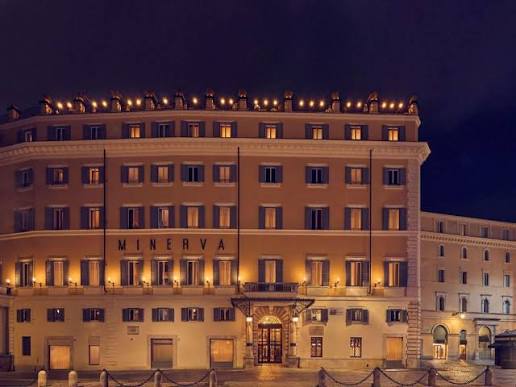
The first point to understand is the nature of the asset itself. The Minerva is not merely a prestigious hotel; it is a trophy asset in the fullest sense of the term. Located at Piazza della Minerva 69, just steps from the Pantheon, within a 17th-century palazzo, it occupies one of the rarest and most defensible positions in Rome’s historic core. Accor describes the property as a luxury hotel in the historic heart of Rome, housed in a 17th-century building and situated just minutes from the city’s principal landmarks.
In prime hospitality real estate, true scarcity is not defined solely by product quality. It lies in the impossibility of replicating the combination of location, history, recognisability, and international appeal. The Minerva brings all of these attributes together. That is why its value cannot be assessed through traditional hotel operating metrics alone. It is an asset that exists on two levels simultaneously: the operating level of the hotel business and the asset-level value created by embedded scarcity.
Arsenale’s entry was not opportunistic
In February 2021, Arsenale signed a preliminary agreement to acquire the vehicle controlling the historic hotel. According to reporting by Pambianco, the property continued operating throughout 2021 under the management of the Billi family, before the launch of a renovation programme scheduled to begin in 2022 and expected to last approximately twenty months.
This point is critical. We are not looking at an investor acquiring a property simply to preserve income continuity. We are looking at a platform stepping into an already distinguished asset in order to move it into a higher value category. The distinction is fundamental: in the first case, the objective is operational efficiency; in the second, it is repricing.
The capital structure reinforces that interpretation. In 2022, Oaktree Capital Management invested €300 million in Arsenale; according to Hospitality Investor, the funds were intended to support the company’s growth and the execution of its development pipeline, including the future Orient Express Hotel de La Minerve in Rome. The same source noted that Arsenale is a partnership between Barletta Group and Annabel Holding, which remained the controlling shareholders.
In market terms, the Minerva did not enter a passive ownership structure. It was absorbed into a platform built specifically to unlock value in iconic assets through capital, development, design, and brand strategy.
The core of the deal: a change in category
The decisive point is not the renovation itself, but the fact that the renovation served as the vehicle for a change in category. Following the restoration led by Hugo Toro, the hotel reopened in April 2025 as Orient Express La Minerva. Official communications refer to 93 rooms and 36 suites, and describe the opening as the debut of the first Orient Express hotel in the world.
This is not a branding footnote. It is the heart of the transaction.
An independent historic hotel, however strong its reputation, competes primarily on service, address, legacy, and an established international clientele. A hotel brought into the Orient Express universe competes on an entirely different plane. It enters a system of global desirability in which pricing is supported not only by the quality of the underlying real estate, but by a brand narrative capable of attracting an ultra-high-spending international guest profile. The opening rates communicated by Accor, ranging from €1,000 for a classic room to €15,000 for the signature suites, should not be read as a mere commercial detail. They are a positioning statement.
The point, therefore, is not simply that the Minerva was restored. The point is that it was recast: from a grand historic Roman hotel into a global ultra-luxury address.
Price matters less than the value-creation trajectory
The purchase price does not appear to have been publicly disclosed in the most widely cited communications relating to the transaction and the reopening. But in a case such as this, the most important number is not necessarily the entry price. It is the value-creation trajectory generated by the project.
An asset like the Minerva can be repriced across at least four dimensions:
-
the intrinsic scarcity of the location;
-
the architectural and symbolic quality of the property;
-
the new brand’s ability to sustain materially higher ADR levels;
-
the transformation of the hotel into an even more compelling asset for institutional capital and long-term investors.
This is where it becomes clear why this transaction matters more than many others. Not because it involves a famous hotel, but because it demonstrates that, in the Roman market, maximum value is created when an irreplaceable historic property meets three elements at once: patient capital, a clear strategic repositioning plan, and a global brand.
Why Rome rewards these assets more today than in the past
The Minerva is not an isolated case. It is a symptom of a more mature phase in Rome’s hotel investment market.
For years, many of the city’s historic hotels preserved their prestige through location and heritage alone. Today, that is no longer sufficient. High-end international demand requires higher standards, more coherent product definition, more distinctive design, more sophisticated service delivery, and above all an institutional framework capable of supporting meaningful capital expenditure over time. In that environment, the best assets naturally become the subject of more structured transactions, where traditional ownership gives way to investment platforms, financial sponsors, and brands capable of accelerating value creation.
That is exactly what the Minerva represents: proof that Rome is not only growing as a luxury destination, but also evolving into a more sophisticated investment market. The best assets are no longer valued solely on current cash flow. They are valued on their ability to be transformed into globally relevant luxury real estate assets.
The real lesson of the transaction
The sale of the Grand Hotel de la Minerva to Arsenale matters not because it involves a famous hotel, but because it captures the new paradigm of Roman hospitality real estate.
Today, value no longer resides in hospitality alone. It lies at the intersection of hospitality, real estate, capital, and brand.
Arsenale identified an irreplaceable asset, removed it from the logic of simple operational continuity, embedded it within a luxury development platform, and linked it to one of the most evocative names in global travel. The result is not merely a high-end reopening. It is an asset redefinition.
For those who invest in, own, or advise on hotels in Rome, the message is clear: the highest premium will not accrue to assets that simply preserve their past, but to those capable of converting that past into a new tier of value.
Roberto Necci
Visit the website:
https://www.hotelmanagementgroup.it
Need assistance with hotel deals in Italy?
r.necci@robertonecci.it