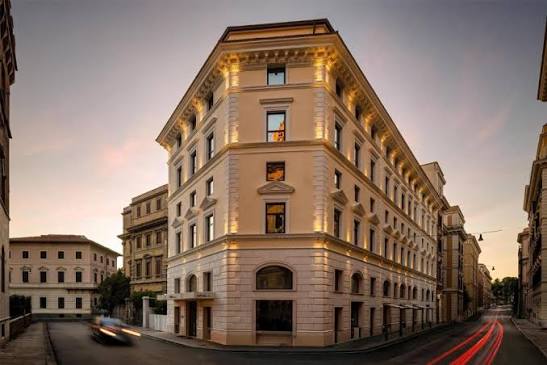
In Rome’s hotel market, the transactions that matter most are not those where an asset is acquired cheaply. They are the ones where investors secure a step-change in value. That is the right lens through which to assess the former Hotel Londra & Cargill, now art’otel Rome Piazza Sallustio: not as a straightforward acquisition, but as a high-conviction repositioning strategy. PPHE did not simply acquire a four-star hotel in central Rome. It acquired the opportunity to convert that asset into a fundamentally different product, with materially stronger pricing power and a far greater ability to attract institutional capital than the property had in its original configuration.
The basic facts are clear. On 11 November 2021, PPHE Hotel Group announced the acquisition of the Londra & Cargill Hotel through its subsidiary, Londra Cargill Parent S.r.l. At the time, the asset was a four-star property with 101 rooms and suites. It was acquired from members of the De Romanis family through a share deal for €34.5 million, with the final amount paid at closing reduced to €33.2 million following customary adjustments. More importantly, PPHE articulated the investment thesis from the outset: the property would be repositioned as an upper-upscale lifestyle hotel. That point is critical, because it makes clear that the purchase price did not represent the asset’s ultimate value. It represented the cost of securing control of a prime micro-location in central Rome with substantial repositioning potential.
That is the first lesson for the market: €34.5 million was not the value of the deal; it was simply the entry ticket. Anyone reading that number as “the price of the hotel” is applying the wrong framework. In sophisticated hotel investments, value is not determined at closing; it is established at stabilization. Put differently, investors do not pay for what a hotel is. They pay for what it can become once brand, design, capex and execution are brought into alignment.
The second phase of the project reinforced that thesis. In March 2024, PPHE announced Pietro Ruffo as the project’s signature artist and Diego Di Gaetano as general manager, describing art’otel Rome Piazza Sallustio as a 99-key premium lifestyle hotel with a destination restaurant and bar concept, an art gallery, and an experience-led positioning built around the integration of hospitality, art and design. In PPHE’s official materials, lead interior design is attributed to Eyal Shoan of Digital Space, not Hugo Toro. That is not a trivial detail. In repositioning transactions, the identity of the creative team is not decorative; it is part of the commercial proposition and, ultimately, part of the value story.
The hotel opened on 6 March 2025 as art’otel Rome Piazza Sallustio, a five-star lifestyle property with 99 rooms, including 11 suites, an art gallery of approximately 60 square metres, YEZI Restaurant & Bar, a fitness centre and a sauna. The official positioning rests on two clear differentiators: the largest permanent display of Pietro Ruffo’s work in a hotel environment, and a guest proposition built not solely around the room, but around a broader ecosystem of art, food, social energy and urban relevance. That is the decisive shift. The asset no longer competes as a well-located four-star hotel in central Rome. It now competes as a lifestyle-luxury destination.
That is where the transaction becomes financially compelling. A traditional hotel creates value primarily through occupancy and ADR. A well-executed lifestyle-luxury asset creates value across four parallel layers: rooms, F&B, ancillary spend and, above all, a brand premium embedded across the entire property. In practical terms, the upside is not confined to revenue per available room. The entire revenue mix improves, and the asset itself becomes more scarce, more investable and more defensible. In hotel real estate, that is the distinction between a well-positioned property and a genuine trophy asset.
Rome, meanwhile, has once again become the right market for this kind of strategy. HVS notes that the city fully recovered to pre-pandemic levels in 2023, that occupancy in 2024 remained consistently above 70%, and that average rates were running roughly 30% above 2019 levels in real terms. The same report highlights that recent development has been concentrated in the luxury segment and that major openings are expected in the coming years, including Ruby Hotel Rome, Rosewood Rome and Brach Roma. In plain terms, PPHE backed a market where demand is present, pricing remains firm, but competition at the top end is intensifying rapidly.
The investment market tells the same story. Colliers reports that the Italian hotel sector reached €1.4 billion in transaction volume in H1 2025, with Rome accounting for 24% of the national total and ranking as the country’s leading investment market. More importantly, 70% of deal flow was driven by value-add strategies: refurbishment, repositioning and performance enhancement. That says something important about today’s market. Capital is not simply looking for hotels to acquire; it is looking for hotels that can be transformed. The Londra & Cargill transaction sits squarely within that framework.
Any advisor-level assessment, however, has to move beyond the success narrative and address the pressure points. The first is execution risk. In 2021, PPHE pointed to an expected reopening in early 2023. As late as August 2024, the company was still referring to an opening in winter 2024/2025. The property ultimately opened on 6 March 2025. PPHE itself linked the delay in positive EBITDA contribution to the extended construction and fit-out programme. That does not undermine the strategy, but it does change the underwriting. When a repositioning slips by two years, indirect costs rise, interest expense accumulates, carrying costs increase, and the asset may enter the market under more competitive conditions than those assumed at acquisition.
The second issue is actual capex. Here, discipline matters. PPHE disclosed the acquisition price, but not the precise refurbishment cost of the individual asset in the sources available. Any discussion of total project cost is therefore an exercise in underwriting, not reporting. Horwath HTL benchmarks for Italy indicate refurbishment costs of roughly €108,000 per key in top destinations and around €123,000 per key in historic hotels. At the same time, the same report makes clear that refurbishing a luxury hotel in a historic building within a prime destination can cost more than a greenfield development. In the case of Piazza Sallustio, given the depth of redesign, revised room mix, art gallery, destination F&B and shift in category, underwriting capex materially above national averages is not aggressive. It is prudent.
That brings us to the central question: how does a €34.5 million acquisition become an asset worth more than €100 million? The answer is straightforward: not through the real estate alone, but through stabilized EBITDA. If the new art’otel remains merely an attractive newly opened hotel, value will settle well below that threshold. If, however, it establishes itself as a genuinely international-calibre asset, with premium ADR, occupancy in line with Rome’s luxury segment, F&B capable of attracting local demand, strong operating margins and credible brand equity, then the value equation changes materially. In purely financial terms, an asset capable of stabilizing EBITDA in the €5.7-6.0 million range is already operating in nine-digit valuation territory. That is not a matter of optimism. It is simply hospitality math.
What makes the case particularly compelling is that the €100 million threshold should not be viewed as an automatic outcome. It is a conditional investment thesis. The base case is an asset that, following repositioning, is worth materially more than its entry cost, but still falls short of true trophy status. The upside case, however, is entirely credible. Rome continues to strengthen as an investment destination, international capital is actively seeking prime product, and the market is rewarding assets with genuine differentiation. HVS notes that, among the hotels traded in Rome during 2024, Sofitel Roma Villa Borghese sold for €74 million, Hotel Cicerone for €70 million, and Midas Palace Hotel Roma for €60 million, while hotel values in the city increased by 1.6% over the year. For art’otel Rome Piazza Sallustio to justify a valuation above €100 million, it will need to prove that it belongs not to the broader category of well-repositioned hotels, but to the much narrower class of prime assets with genuine pricing power.
There is one final misconception worth addressing. Many investors treat the lifestyle segment as an aesthetic formula: better design, stronger storytelling, greater social media visibility. That is an incomplete reading. Lifestyle only creates value when it changes the economic architecture of the hotel. If it raises costs without materially improving RevPAR, ancillary spend and brand equity, it is little more than an expensive overlay. If, by contrast, it changes the customer mix, increases the productivity of public spaces, strengthens local market relevance and upgrades the property’s international positioning, then it becomes a genuine revaluation engine. That is the standard against which the Londra & Cargill repositioning will ultimately be judged, not the visual appeal of the finished product.
The conclusion is therefore clear. This was never just a €34.5 million acquisition. It was a bet that a historic four-star hotel in central Rome could be repositioned into an internationally relevant lifestyle-luxury asset. The industrial logic behind the deal is strong. The parties involved are fully consistent with a high-profile repositioning: PPHE as investor and developer, the De Romanis family as seller, Pietro Ruffo as signature artist, Diego Di Gaetano as general manager, Eyal Shoan leading the interior concept, with legal and tax advisory reportedly provided by Gianni & Origoni and KPMG.
There is only one credible top-advisor conclusion: PPHE did not buy a hotel; it bought a value gap it believed it could close. A valuation above €100 million is not implausible, but neither is it preordained. It becomes credible only if the asset can translate rebranding into sustained profitability. And in hotel investment, that is always where the divide lies between transactions that are merely impressive and those that are genuinely exceptional.
Roberto Necci
Visit hotelmanagementgroup.it
For confidential assistance on hotel deals in Italy: r.necci@robertonecci.it