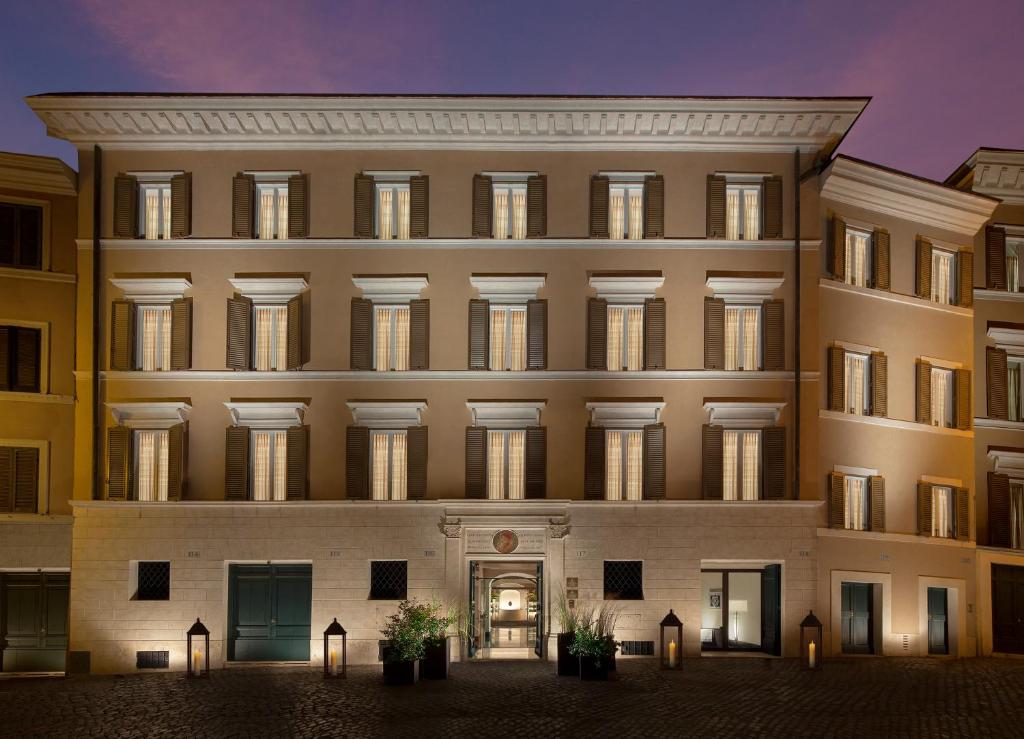
The acquisition of Palazzo Scanderbeg is not simply a portfolio addition. It is a clear statement of strategy. In a luxury market increasingly shaped by standardisation at scale, Ginobbi Group is backing a different model: fewer keys, stronger identity, tighter operational control and more defensible asset-level economics.
In upper-upscale and luxury hospitality real estate, the most meaningful transactions are rarely the ones that add the most inventory. They are the ones that reveal a method. Ginobbi Group’s acquisition of Palazzo Scanderbeg should be read in exactly those terms: not as a routine change of ownership in central Rome, but as a strategic proof point in an increasingly coherent investment and operating thesis.
For years, the sector relied on a familiar formula: acquire a landmark asset in a prime location, invest in refurbishment, attach the right brand, push rates and capture value through repositioning. That formula still has relevance, but it is no longer enough on its own. In a city such as Rome, where international capital, global operators and new luxury supply continue to converge, a prestigious address is no longer a sufficient differentiator. Scarcity still matters, but scarcity without strategic interpretation has become a weaker proposition.
What matters now is the ability to turn a rare address into a rare product.
That is what makes Palazzo Scanderbeg strategically important. The asset is not compelling simply because of where it sits, but because of what it can become within the right operating framework. With its highly selective scale, intimate setting and strong suitability for bespoke service, the property lends itself to a form of hospitality that is not driven by conventional mass, but by precision: precision in positioning, in service design, in customer targeting and in revenue architecture.
This is not an asset that creates value by being filled. It creates value by being understood.
That distinction is central. Luxury hospitality is increasingly fragmenting into more nuanced demand profiles. A growing cohort of internationally mobile, high-spending travellers is no longer looking only for the traditional five-star hotel experience, however polished. That demand is shifting towards something more specific: privacy without isolation, space without residential inefficiency, service without theatricality, and flexibility without loss of status. In practical terms, that means the market is moving toward more sophisticated forms of serviced residential luxury, particularly in gateway destinations where identity and locality still matter.
Palazzo Scanderbeg sits squarely within that evolution. Its strategic relevance lies not only in its location and character, but in its ability to operate within a hybrid segment that is becoming increasingly valuable: high-end suites and apartments designed for premium short and extended stays, aimed at guests who want exclusivity, recognisable service standards and a stronger sense of place than many branded luxury products now deliver.
Seen from that angle, the transaction does more than expand Ginobbi Group’s presence in Rome. It sharpens the Group’s market identity.
That identity has already been taking shape. Palazzo Ripetta established an important benchmark: a luxury urban hospitality asset combining heritage, service depth, modern management and a clear experiential narrative. Torre Sponda in Positano extended the same philosophy into a more rarefied leisure and villa environment. Palazzo Scanderbeg adds a further layer of clarity. It reinforces the idea that the Group is not attempting to build scale for its own sake. It is building a portfolio logic around high-quality, low-density, experience-led assets where the economics are supported by positioning strength rather than inventory volume.
This is an important distinction, and one that many market participants still underappreciate.
In mature luxury markets, growth is not necessarily about adding more rooms. In many cases, it is about assembling a portfolio of assets capable of sustaining pricing power, reputational relevance and margin resilience over time. That requires a different kind of discipline. It requires saying no to volume when volume dilutes identity. It requires preferring operating coherence over superficial footprint expansion. And it requires understanding that the best luxury assets are not always the largest or the most visible, but often the ones with the strongest control over how value is created and defended.
Rome provides a particularly revealing backdrop for this strategy. The city remains one of Europe’s most attractive urban hospitality markets, but it is no longer a forgiving one. Competition at the top end is intensifying. International operators continue to deepen their presence. New luxury supply is reshaping the competitive field. In that environment, prime location alone does not guarantee defensibility. In some cases, it merely increases the penalty for mediocre execution.
A prime address can attract attention. It cannot, by itself, sustain rate integrity.
What protects value instead is a sharper combination of product identity, customer relevance and operating discipline. That is where this deal becomes more than an acquisition. It becomes a positioning move. Ginobbi is not merely increasing exposure to prime Rome. It is making a more deliberate claim about where it believes long-term value will sit within the luxury hospitality spectrum: iconic assets, tightly curated scale, high-touch service and deep integration between ownership strategy and operational management.
From a capital allocation standpoint, that matters. The logic here is not indiscriminate expansion. It is selective concentration. Properties are attractive not simply because they are prestigious, but because they offer rarity, repositioning potential and strategic fit within a broader platform thesis. That is a more sophisticated proposition than many portfolio-building strategies in the sector, which too often confuse asset collection with value creation.
The comments made by Federica Schiavo and Giacomo Crisci reinforce this reading. Together, they point to a framework rooted in disciplined growth, active asset management and medium- to long-term value enhancement. The language matters because it signals intent. This is not the language of trophy ownership for its own sake. It is the language of portfolio design, return quality and selective expansion within a segment where not all luxury assets are equal.
And that last point is crucial.
Luxury, today, is no longer just a branding exercise. It is a structural equation. Capital structure matters. Product architecture matters. Demand quality matters. Operating precision matters. A property like Palazzo Scanderbeg will not succeed merely because of its inherent prestige. It will succeed only if that prestige is converted into a disciplined commercial strategy, an unmistakable guest proposition and a service model that justifies both rate and loyalty.
That is where the real test begins.
Because the risks are real. Rome’s luxury market is becoming more crowded. Historic assets come with operational complexity, maintenance intensity and capex sensitivity that can quickly erode the elegance of an investment thesis if execution slips. Small-scale formats, for all their strategic advantages, also compress the margin for error. With limited key count, every pricing decision carries more weight. Every service inconsistency is more visible. Every deviation in positioning is harder to absorb.
In large hotels, inefficiency can sometimes be diluted. In small luxury assets, it is exposed.
That is precisely why this transaction deserves attention. Not because it is risk-free, but because it reflects an operator willing to compete where execution matters more than narrative. The involvement of institutional financing counterparties and a structured lending framework further underlines that this was not approached as a symbolic acquisition. It was approached as a serious hospitality real estate investment with an operating thesis attached.
And that is what distinguishes stronger deals from merely attractive ones.
Ultimately, the significance of Palazzo Scanderbeg lies in what it signals to the wider market. Ginobbi Group is effectively arguing that the next chapter of Italian luxury hospitality will not belong exclusively to global brands, nor to passive owners of iconic buildings. It will also belong to those independent groups capable of being more selective than the chains, more operationally rigorous than purely real estate-led investors, and more distinctive than standardised luxury platforms.
That is a credible thesis. More importantly, it is a timely one.
Palazzo Scanderbeg is not just another trophy asset entering a portfolio. It is evidence of a sharper idea: that in luxury hospitality, enduring value is created not by owning exceptional properties alone, but by applying an exceptional method to them.
Roberto Necci
Visit the website: https://www.hotelmanagementgroup.it
For advisory support on hospitality deals in Italy: r.necci@robertonecci.it